


Healthy Urban & Buildings (HUB) Lab

RESEARCH INTERESTS

Urban Sensing and Analytics
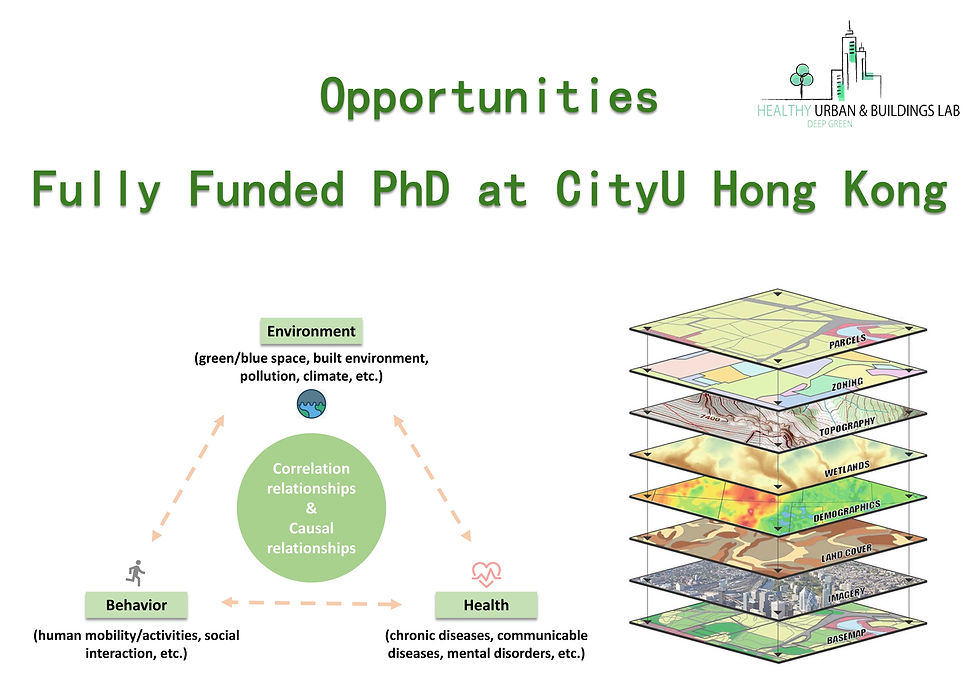
Drawing on diverse geo-referenced sensing data (e.g., street view images, satellite images), we aim to employ advanced urban sensing and analytics techniques (e.g., computer vision and GeoAI) to precisely assess urban built environment.

Nexus between Environment, Behavior, and Health
We excel in conducting cross-sectional studies to explore the correlation relationships between environment, behavior, and health. Additionally, we are proficient in conducting longitudinal studies to infer causal relationships.

Geospatial Big Data Mining and Spatial modelling
Leveraging multi-source geospatial big data, we aim to employ diverse GIS techniques to uncover intriguing space-time patterns and phenomenon within cities, which contributes to pursuit of sustainable urban development.

ABOUT
Urban design and architecture reflect and guide existing human experience; they also stimulate and generate new human experience. The evolution of technologies, lifestyles, culture, and pandemics continuously redefines the way in which built environment supports healthy behaviors and outcomes.
The Healthy Urban and Building Lab (HUB) develops tools, models and theories for better understanding, quantifying and evaluating the performance of built environment relative to its human behavior and health. HUB creates credible evidence linking design decisions to health outcomes and makes these findings usable for designers and decision-makers.
In lecture, funded research, consultation, training, HUB works with other universities, design firms, and policy makers to provide significant and measurable economic, social and health improvement to the built environment in many cities in China and overseas, with important follow-on impacts on the quality of citizens’ lives. HUB also contributes to the development of street design and greenspace design guidelines for several major cities in China, such as Wuhan, Nanjing, and Shanghai.
Latest Publications
-
Liu, D., Wei, D., Ho, H. C., Li, M., & Lu, Y. (2026). Linking window-view nature exposure with health and wellbeing outcomes: Using photorealistic 3D city models and computer vision technique. Landscape and Urban Planning, 270, 105601. (see more details)
-
Li, Z., Lu, Y., Wang, J., & Wu, Y. (2026). Rail transit and travel satisfaction: Evidence from a natural experiment in Wuhan. Travel Behaviour and Society, 43, 101211. (see more details)
-
Zhou, Y., & Lu, Y. (2025). Varying relationships between experienced income segregation and travel behaviour across neighbourhood social and urban contexts. Nature Communications, 16(1), 11236. (see more details)
-
Zhou, Y., & Lu, Y. (2025). Experienced economic segregation and associated mental health inequalities across urbanicity. Social Science & Medicine, 118813. (see more details)
-
Liu, F., Lu, Y., Song, Q., Qiu, W., & Liu, D. (2025). The association of subjective physical disorder and pedestrian volume: A big urban data and machine-learning approach. Computers, Environment and Urban Systems, 122, 102348. (see more details)
News & Events

HUB Lab director Dr. Yi Lu and PhD students Dongwei Liu, Zhenhua Li, Yuxuan Zhou attended AAG 2024 annual meeting

Congrats to Prof. Lu for being awarded as a Highly Cited Researcher in 2023!
Collaboration
HUB Lab has established collaborations with prestigious universities, including the University of Hong Kong, Southeast University, Wuhan University, Huazhong University of Science and Technology, Tianjin University, Sun Yat-sen University, Tongji University, and East China Normal University, etc. We warmly welcome interdisciplinary collaborations with teams worldwide.